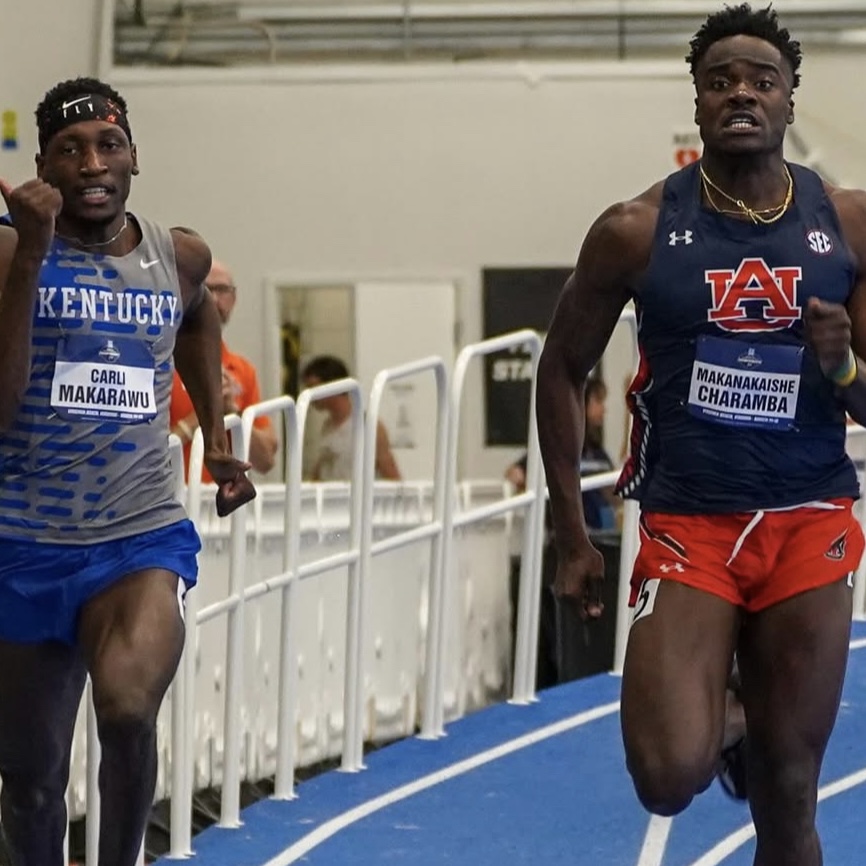

Rising Stars & Established Names
The final stretch before the mid-summer championship season became a proving ground, and the Prefontaine Classic at Hayward Field was the marquee stop. From record-tying breakthroughs to hard-fought top-ten finishes, African athletes measured themselves against the very best in the world.
Championship season has a way of separating the contenders from the merely present, and the meets of late June and early July handed African athletes exactly that kind of test. On the sport’s biggest one-day stages — the Prefontaine Classic chief among them — they lined up against Olympic champions, world record holders, and a wave of teenage phenoms, and came away with wins, near-misses, and a clear read on where the continent stands heading into the Commonwealth Games.
This is not a pure quality ranking. It is a story of how African athletes fared against the world’s best across every discipline — sprints, hurdles, throws, and the distance events where the continent has long set the terms. Some of these performances were victories. Others were seventh- and eighth-place finishes in fields so deep that simply being there was the achievement. All of them tell you something about the shape of African athletics right now.
The performances below are verified against official Diamond League and World Athletics coverage as of July 5, 2026. Marks, placings, and head-to-head results are reported exactly as confirmed. Where a result reflects a debut, a record, or a notable head-to-head, that context is noted alongside the mark.
Ten Performances That Defined the Week
There are gentle ways to introduce yourself to the Diamond League, and then there is winning the 100m outright. Ajayi chose the latter, tying his own Nigerian national record of 9.84 to hold off a field of established professionals in his first outing at this level — with Jamaica’s Oblique Seville (9.89) and America’s Christian Coleman (9.95) both behind him.
A 9.84 is not a soft national record, and tying it against seasoned Diamond League sprinters in a debut is the kind of result that reorders expectations. Ajayi’s strength remains his top-end phase — the drive and transition that let him pull clear over the second half — and beating Seville and Coleman, two men with championship pedigree, says his form is no fluke of the collegiate circuit. He arrives as a genuine sprint force, not a prospect.
A national-record-tying win over established pros in his first Diamond League start marks Ajayi as a serious addition to Nigeria’s sprint depth heading into the Commonwealth Games.
Source: Diamond League & World Athletics official results.
The one-lap event rarely rewards patience, but Kebinatshipi timed his move to perfection — running down Rai Benjamin over the final 100 metres to win in 44.00, with the Olympic hurdles champion crossing just behind in 44.11.
Clocking 44.00 puts a man on the doorstep of the sub-44 club, rare air in the 400m that only a handful reach in any season. What impresses here is the closing speed: catching and passing an athlete of Benjamin’s calibre over the last 100 metres demands both exceptional speed endurance and the composure to hold form when the lactate hits hardest. Botswana’s quarter-mile pedigree, already deep, gains another genuine international-class name.
Sub-44 clockings are rare air in the one-lap event, and beating an Olympic champion in a flat-400m outing underlines Botswana’s quarter-mile pedigree.
Source: Diamond League & World Athletics official results.
One of the meet’s biggest upsets unfolded in the 200m, where Tebogo was beaten to the line by 18-year-old American high schooler Tate Taylor, who stunned the field with 19.75. Tebogo’s 19.93 was itself a strong run — it simply ran into a generational performance on the day.
A sub-20 clocking from Tebogo is business as usual for the Olympic champion, and on most days it wins. Losing to a 19.75 from a high schooler says more about the extraordinary emergence of Taylor than any dip in Tebogo’s level. His relaxed, high-velocity curve and long straightaway stride remain among the best in the sport; the margin here is a matter of one athlete having the run of his life, not a flaw in Tebogo’s model.
Even in defeat, staying competitive against a surprise breakout shows Tebogo remains among the sport’s elite — and sets up an intriguing rematch narrative for the rest of the season.
Source: Diamond League & World Athletics official results.
Amusan, the world record holder in the event, finished second behind Masai Russell, who equalled the meeting record with 12.24. A 12.34 against that level of opposition is a marker of an athlete in fine early-season form.
Hurdling at this level is a game of hundredths, decided by rhythm between the barriers and the efficiency of the trail leg. Amusan’s 12.34, run against a meet-record-equalling 12.24, shows her signature clockwork cadence is intact. For the world record holder, a sharp runner-up finish in a quality field is exactly the kind of competitive tune-up that keeps an athlete honed rather than over-raced ahead of the championships.
As the world record holder, a runner-up finish against strong opposition keeps Amusan sharp and in the conversation heading into major championships.
Source: Diamond League & World Athletics official results.
Fresh off his NCAA title, Zimbabwe’s Tafadzwa Chikomba was back in the sand at the Maximum Velocity meet in Chula Vista, and he picked up right where he left off — a best of 8.36m on the day, alongside a wind-aided leap of 8.52m. For a jumper who has spent all season rewriting Kansas State and collegiate record books, it was another statement that his breakthrough year has real staying power.
Backing up a championship-winning jump weeks later with another series beyond 8.30m is the mark of a jumper whose form is built to last, not peak once and fade. Chikomba’s sprint speed on the runway remains his engine — approach velocity is the single biggest determinant of distance — and the 8.52m, though over the wind limit, hints at the raw range he is now operating in. His challenge, as with any elite jumper, is converting that runway speed into legal distance at the board; on current evidence, the marks near and beyond 8.30m are becoming routine.
Another 8-metre series so soon after his NCAA crown confirms Chikomba as one of the most consistent long jumpers in the world in 2026 — and, with the African record within sight, a genuine medal threat for Zimbabwe as the championship season arrives.
Source: Maximum Velocity meet results, Chula Vista (July 4, 2026) via AthleticLIVE.
Onojuvwevwo made an impressive Diamond League debut, recording another sub-51-second time in a race won by Jamaica’s Dejanea Oakley in 49.64. Fifth place in that company, with the consistency to keep dipping under 51, is a debut to build on.
The 400m is the most metabolically brutal of the sprints, and holding sub-51 form race after race is a durability signal as much as a speed one. Onojuvwevwo’s ability to run competitively against an international field in her first Diamond League start — rather than fading in the final 100m, where debutants often unravel — points to a well-managed endurance base. She is the kind of athlete who deepens a relay pool and pushes the established names in training.
A fifth-place finish against a stacked international field, combined with consistent sub-51 form, signals real depth developing in Nigerian women’s sprinting.
Source: Diamond League & World Athletics official results.
Enekwechi, the reigning African record holder at 22.10m, produced a best of 21.36m in a circle won by Italy’s Leonardo Fabbri at 22.74m. The mark sat below his season best, but the field itself told the story — seven throwers cleared 20 metres.
A 21.36m put is a long way for most of the world and a touch short of Enekwechi’s own lofty standard. In a circle with seven men beyond 20 metres, staying in the mix requires both the raw strength and the technical repeatability to deliver under pressure throw after throw. Competing at this density of quality — rather than dominating a weaker field — is precisely the preparation a thrower wants before a championship where he carries captain’s responsibilities.
The mark was below his season best, but competing in a field with seven throwers over 20 metres kept him among the world’s top shot putters — useful preparation ahead of the Commonwealth Games, where he captains Team Nigeria.
Source: Diamond League & World Athletics official results.
Sekgodiso finished seventh in a two-lap race of exceptional depth, topped by Kenya’s Lilian Odira (1:56.19) ahead of Olympic champion Keely Hodgkinson (1:56.73). Running 1:58.79 in that company is no small feat.
A sub-1:59 in a field this loaded is a genuinely strong run that the finishing position undersells. The 800m rewards an athlete who can sit in a fast pace without panicking and still have something for the home straight, and Sekgodiso’s time indicates she was racing the pace rather than merely surviving it. Exposure to Odira and Hodgkinson at close quarters is the kind of experience that pays off when the championship rounds arrive.
Racing in a field that included the world and Olympic champions is valuable exposure, and South Africa’s middle-distance program continues to produce athletes capable of lining up at that level.
Source: Diamond League & World Athletics official results.
Cherotich won convincingly, holding off Bahrain’s Winfred Yavi (8:52.84) and Tunisia’s Marwa Bouzayani — who ran a national record 8:54.32 for third. A win of this quality, over opposition this strong, is a reassertion of the established order.
The steeplechase blends flat-out running speed with the rhythm and nerve to clear 28 barriers and seven water jumps without losing momentum. Beating an athlete of Yavi’s calibre, and pushing Bouzayani to a national record in the process, means Cherotich won a fast race rather than a tactical crawl. Her barrier efficiency and closing strength kept her clear when it mattered — the hallmarks of a championship-ready steeplechaser.
Kenya’s steeplechase dominance remains intact, and a win of this quality against strong opposition reinforces East African leadership in the event.
Source: Diamond League & World Athletics official results.
Cheruiyot finished fifth in a mile of staggering depth, won by Australia’s Cameron Myers in an area record 3:46.06, with nine men breaking 3:49. His 3:47.39 in that context is a serious run.
When nine men break 3:49 in a single race, fifth place is a far better result than the number suggests. The mile at this depth is a test of positioning and sustained speed, and Cheruiyot — a former world 1500m champion — showed he still belongs in the front group of the fastest fields on the circuit. It is a useful benchmark and a marker that Kenya’s middle-distance kingpin remains relevant as a new generation rises.
Staying competitive in one of the deepest mile fields of the season keeps Cheruiyot relevant in the 1500m/mile conversation and provides a benchmark for Kenya’s next generation of milers.
Source: Diamond League & World Athletics official results.
The Week in Full: Key Takeaways
A New Generation Announces Itself
Kayinsola Ajayi did not ease into the Diamond League — he won it, tying a national record over Seville and Coleman in his debut. Busang Kebinatshipi ran down an Olympic champion to dip toward sub-44. These are not prospects hoping to belong; they are athletes who arrived and won, and they reset expectations for what the continent’s next wave can do on the biggest one-day stages.
Depth Is the Real Story
The headline victories mattered, but so did the seventh- and eighth-place finishes. Prudence Sekgodiso running sub-1:59 against the world and Olympic champions, Tafadzwa Chikomba backing up his NCAA title with another 8-metre series, Chukwuebuka Enekwechi holding his own in a circle with seven 20-metre throwers — these are the results that show African athletics is no longer top-heavy. The strength runs deep across nations and events.
The Established Order Holds Where It Always Has
Faith Cherotich’s convincing steeplechase win and Timothy Cheruiyot’s top-five in a historically deep mile were reminders that East Africa’s distance dominance is not going anywhere. Even Letsile Tebogo’s narrow 200m defeat — to a once-in-a-generation high-school run — underlined that the continent’s stars are still the measuring stick others are chasing.
Frequently Asked Questions
Which African athletes won at the Prefontaine Classic and Diamond League in early July 2026?
Nigeria’s Kayinsola Ajayi won the men’s 100m in 9.84, Botswana’s Busang Collen Kebinatshipi won the 400m in 44.00, and Kenya’s Faith Cherotich won the women’s 3000m steeplechase in 8:51.74.
How did Letsile Tebogo perform at the 2026 Prefontaine Classic?
Botswana’s Letsile Tebogo finished second in the 200m in 19.93, beaten to the line by 18-year-old American Tate Taylor, who ran 19.75 in one of the meet’s biggest upsets.
What did Tafadzwa Chikomba jump at the Maximum Velocity meet in 2026?
Zimbabwe’s Tafadzwa Chikomba jumped a best of 8.36m at the Maximum Velocity meet in Chula Vista on July 4, 2026, along with a wind-aided 8.52m — another strong series just weeks after his NCAA long jump title.
Did any African athletes set records in early July 2026?
Kayinsola Ajayi tied his own Nigerian 100m national record with 9.84 in his Diamond League debut win, and Tunisia’s Marwa Bouzayani ran a national record 8:54.32 for third in the women’s steeplechase.
Winners, Near-Misses, and a Continent Building Toward the Summer
Taken together, these results reflect a continent with real strength across sprints, jumps, throws, and distance — and, just as tellingly, plenty of room still to grow, from narrow defeats to below-season-best marks. Nigeria, Botswana, Kenya, and South Africa each produced standout moments, while the depth on display hints that more nations will push into the world’s top tier as the outdoor season builds.
The Commonwealth Games and the heart of the championship season lie just ahead. On this evidence, African athletics arrives not as a hopeful challenger but as a settled force — winning where it always has, and now winning in places it never used to. TheSeanCast will be trackside for all of it.
This roundup measures how African athletes performed against international fields at the Prefontaine Classic and other meets in late June and early July 2026. It is not a pure quality ranking; it includes victories and top-ten finishes across all events, distance included. All results are verified against official Diamond League and World Athletics coverage as of July 5, 2026, and are subject to ratification.